
AI shelf monitoring that checks every store, not just the ones you visit.
AI for business · Shelf & POSM monitoring · Jakarta
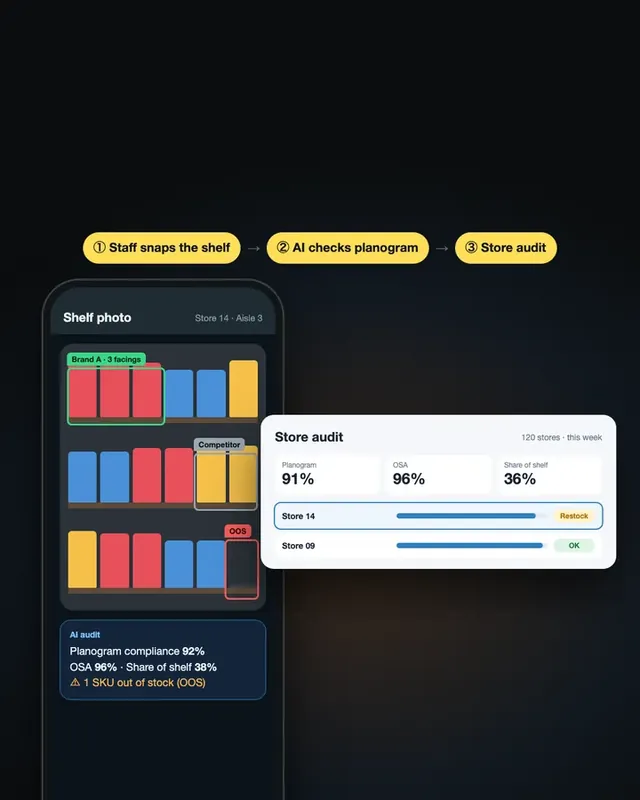
Field staff take a photo, or a camera watches the display. Computer vision checks the shelf against the planogram and tells you what to fix, store by store.

What’s Included
Planogram Compliance
Each shelf photo is checked against the planogram: right products, right place, right facing.
On-Shelf Availability (OSA)
Empty slots and out-of-stock products are flagged before they cost a sale.
Share of Shelf
How much of the shelf your brand holds against competitors, per store and per region.
Promo & Price Tag Checks
Whether the promo material and price tags are up, correct and visible.
POSM & Display Analytics
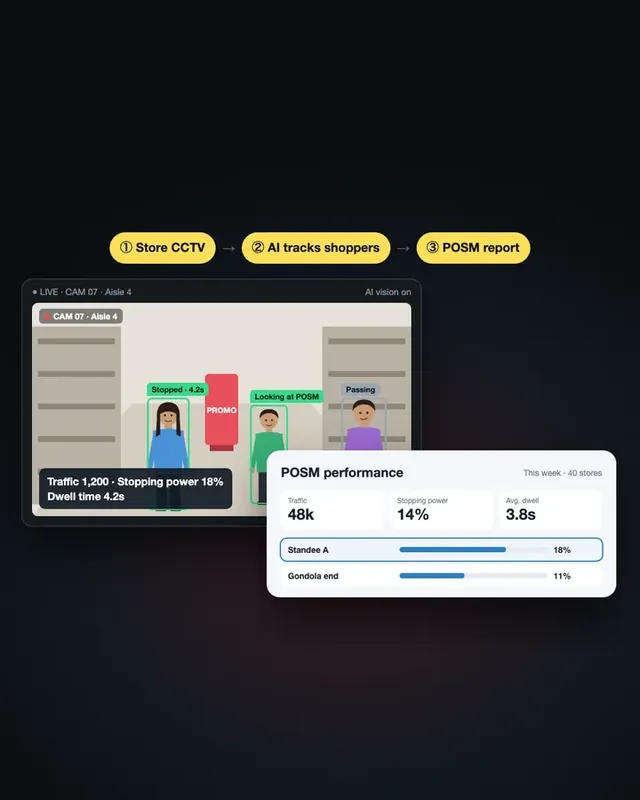
Foot traffic, stop rate, engagement and dwell time per display, so budget goes where it works.
Dashboard & Field Tasks
Scores by store, area and visit, with the fixes sent back to the field team.
Results from Our Projects
1,200foot traffic measuredPOSM analytics
18%engagement ratePOSM analytics
4.2saverage dwell timePOSM analytics
AI Shelf Monitoring, Explained
What Is AI Shelf Monitoring?
AI shelf monitoring uses computer vision to read photos or video of a store shelf. It recognises each product, compares the shelf with the planogram, and reports what is missing, misplaced or out of stock. It replaces checking every shelf by hand with a photo and a score.
What It Can Check
- Planogram compliance: the right products in the right place, with the right number of facings.
- On-shelf availability (OSA): empty slots and out-of-stock products.
- Share of shelf: your brand's space against competitors.
- Promo and price tags: whether point-of-sale material is up and correct.
- Display performance (POSM): with a camera, how many people pass, stop and look at a display. In one rekursiv. project the system measured 1,200 passers-by, an 18% engagement rate and 4.2 seconds of average dwell time.
Photos or Cameras?
Photos taken by merchandisers are the fastest start: no hardware in the store, and every visit becomes data. Fixed cameras suit displays and flagship stores where you want continuous numbers. Many brands start with photos and add cameras where it matters.
What Drives the Cost
The number of products (SKUs) the model must recognise, the number of stores, photos or cameras, how often shelves are checked, and the reports and integrations you need. We scope it after a pilot on a handful of stores.
Privacy
Shelf photos don't need faces. Camera-based display analytics count people and measure dwell time without identifying anyone.
Why rekursiv. for Shelf Monitoring
Trained on Your Products
The model learns your SKUs and packaging, including new launches.
Built for the Field
A simple photo flow merchandisers actually use, even on a slow connection.
From Score to Action
Fixes go back to the field team, not just into a report.
One Team
Computer vision, app, dashboard and rollout from the same people.
Industries: FMCGRetail & minimarketsBeveragesPersonal carePharma & OTC
How We Work
- 01Map the check people do by hand today, and what a good result looks like.Process map
- 02Pilot on a few sites or stores with your real footage or photos.Pilot on site
- 03Tune the model on your products, uniforms or faces, until it’s accurate on the floor.Tuned model
- 04Roll out to more sites, with alerts and a dashboard your team actually opens.Dashboard & alerts
- 05Report what changed, with numbers you can show management.Impact report
Projects
 Planogram & OSA, checked by AIAI Shelf Monitoring▶︎ Video
Retail & FMCG
 Which POSM stops shoppers?In-Store Display (POSM) Analytics▶︎ Video
Retail brands1,200 foot traffic
 Lift it, learn itLift & Learn Retail Display▶︎ Video
FMCG
 Feedback people enjoy givingCuriosity Screen: Feedback People Enjoy Giving
FMCG
Frequently Asked Questions
What is planogram compliance?
Whether a shelf matches the planogram: the agreed layout of which products go where and how many facings each gets. AI checks it from a photo instead of a manual audit.
What is on-shelf availability (OSA)?
The share of products that are actually on the shelf when a shopper looks for them. AI flags empty slots and out-of-stock products per store.
Do we need cameras in every store?
No. Most brands start with photos taken by merchandisers on their phones. Cameras are added where you want continuous data, such as key displays.
How accurate is AI shelf recognition?
Accuracy depends on how well the model is trained on your products and on photo quality. We train on your SKUs, test in real stores during a pilot and report accuracy before rollout.
Can it measure our in-store displays (POSM)?
Yes. With a camera, it counts foot traffic, stops, engagement and dwell time per display, so you can compare locations.
How long does a pilot take?
It depends on the number of SKUs and stores. We agree the scope, stores and success measures together before we start.
Does it identify shoppers?
No. Shelf checks use product photos, and display analytics count people without identifying them.
Read More
 AI for businessWhatsApp AI Agents for Business: Orders, Customer Service and Automatic ReportsHow an AI agent differs from a menu chatbot, real uses for orders, customer service and internal operations, how it works, and what to prepare in Indonesia.
 Research & UXUX Research vs Surveys: Which One Do You Need?Surveys tell you what people say; UX research shows what they do. When to use each, how to combine them, and real examples from studies in Indonesia.
Next step