Corporate Banking UX: How to Design a Wholesale Banking Platform
Corporate banking UX for wholesale banking platforms: roles and approvals, bulk payments, cash position and redesigns that keep existing users confident.
In this article
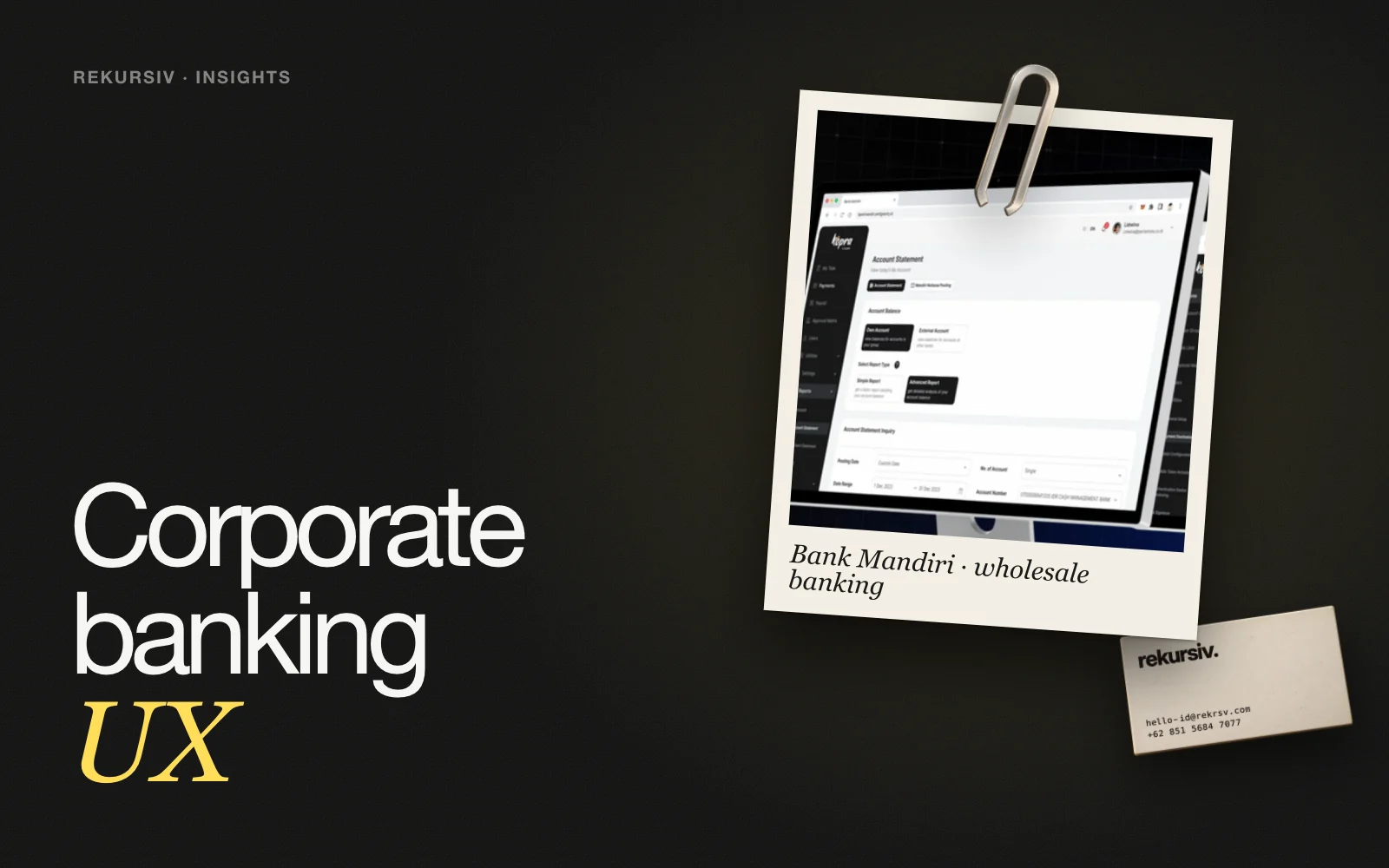
Corporate banking UX is the design of the platforms banks give to companies: wholesale banking portals, cash management systems and the tools finance teams use every day. Unlike a personal banking app, these platforms serve whole teams with different roles, approval limits and many accounts. Good design lets a treasurer see the cash position at a glance, lets a staff member prepare payments quickly, and lets an approver release them with confidence.
See our UI/UX design service and fintech app development service.
Who Uses a Wholesale Banking Platform
A single company account is usually shared by several people, each with a different job:
| Role | What they need from the platform |
|---|---|
| Maker | Prepare transfers and bulk payments fast, with clear validation |
| Checker / approver | See what is waiting, review details, approve or return in a few steps |
| Finance manager or treasurer | Cash position across accounts, cashflow, reports |
| Company admin | Add users, set roles and approval limits |
| Auditor | A complete history of who did what and when |
Designing for only one of these roles creates friction for the others. The platform has to work for all of them on the same data.
The Screens That Matter Most
Cash Position and Cashflow
The first screen a finance team opens. It should answer "how much do we have, where, and what is moving" across every account, without exporting to a spreadsheet first.
Transactions
Search and filters do most of the work here: by account, date, amount, status and counterparty. Status labels should match how finance teams talk, such as pending approval, released or returned.
Bulk Payments
Payroll and vendor payments often go out as one file. Clear upload steps, line-by-line validation and a summary before submission reduce rework.
Approvals
A single inbox for everything waiting on the current user, with the amount, the maker and the approval chain visible in one view.
Users and Permissions
Admins need to see and change roles and limits without calling the bank.
Principles for Corporate Banking UX
- Design for the workflow, not the screen. Map the full path of a payment from maker to release, then design each step.
- Make status visible everywhere. Every transaction should show where it is and who it is waiting on.
- Bring connected processes into one place. Finance teams lose time when related tasks live in separate systems.
- Keep dense data readable. Corporate users work with long tables; clear hierarchy, alignment and sensible defaults matter more than decoration.
- Respect what users already know. Long-time users have habits. Keep familiar tasks easy to find while the interface improves.
- Handle personal data carefully. User and beneficiary details fall under UU PDP No. 27/2022, so access should follow roles.
What Our Banking Projects Did
 Bank MandiriSee the project →
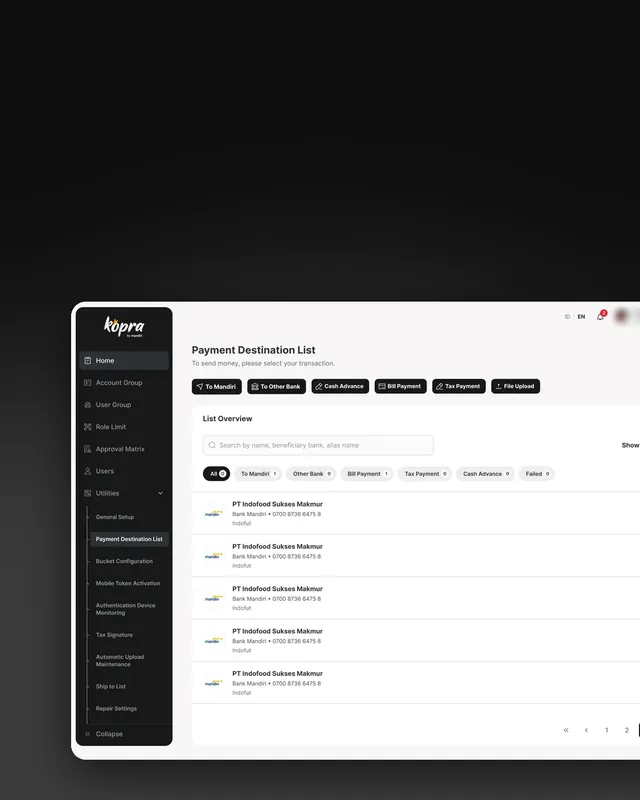
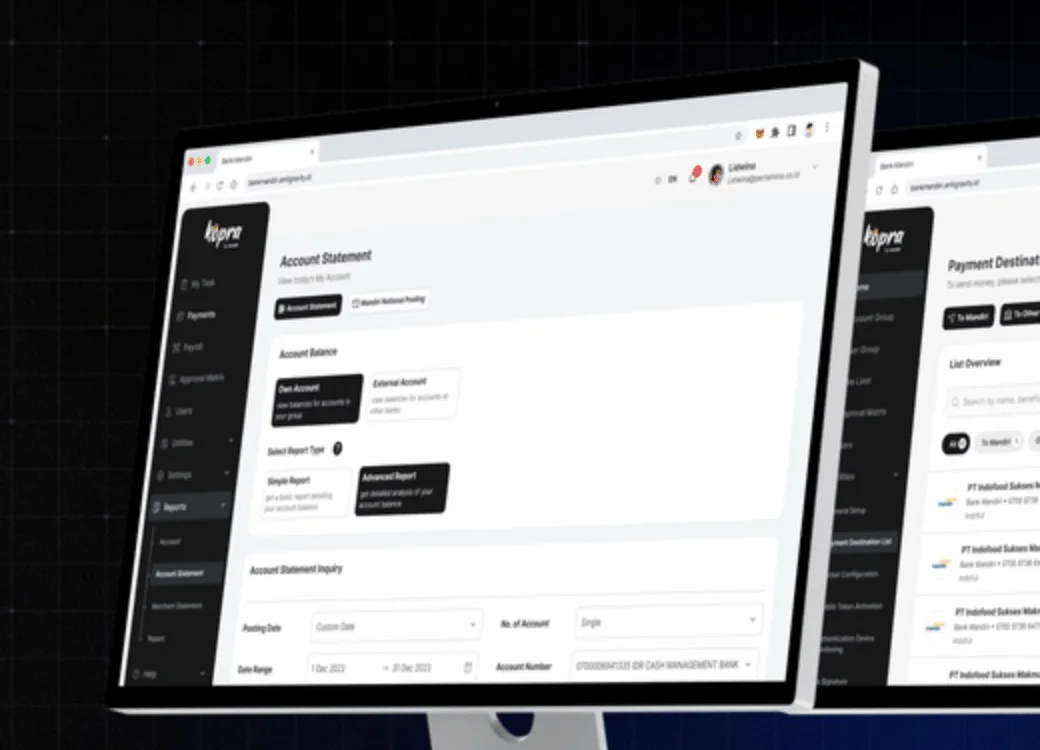
Bank Mandiri, wholesale banking platform. The starting point was a wholesale management system that was slow and poorly connected, which caused delays. We redesigned and integrated the key wholesale processes into one streamlined platform, covering UX/UI design, web development and process integration.
 Bank BTNSee the project →
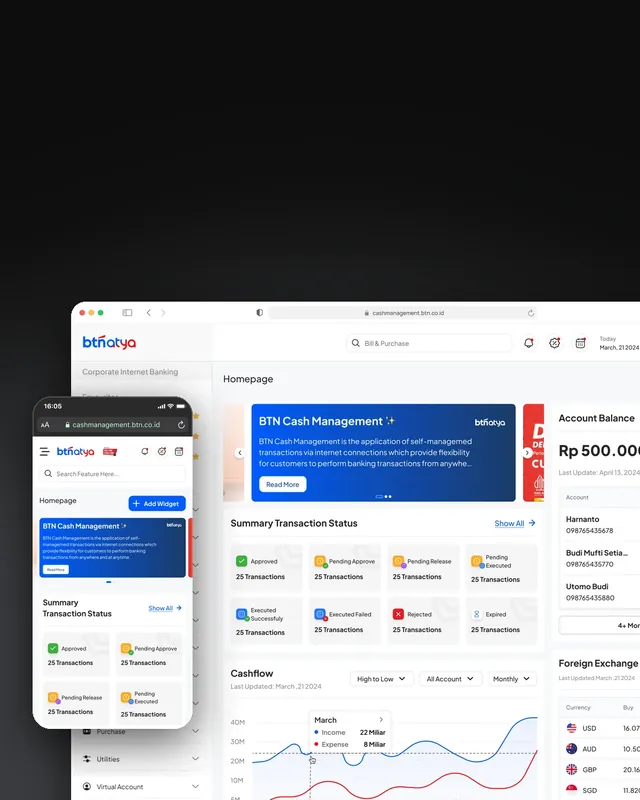
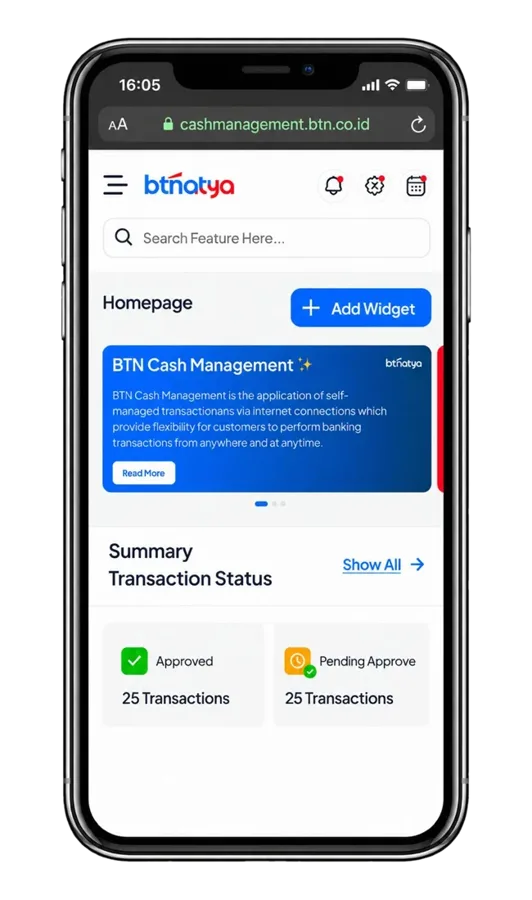
Bank BTN, Cash Management System. The brief was to revamp an outdated cash management interface without confusing the corporate clients who already rely on it. The goals were to modernize the interface, keep existing corporate users confident, and surface cashflow and transactions at a glance. The work included usability testing with 10 participants, a heuristic evaluation, affinity mapping, and UX and UI design.
Research Methods That Fit Corporate Banking
- Usability testing with real corporate users, on real tasks such as preparing a bulk payment or finding a transaction.
- Heuristic evaluation of the current platform to list issues before testing.
- Affinity mapping to group findings into clear themes the bank can act on.
- Prototype testing of the new flows before development starts.
These methods work well for corporate platforms because each user handles high-value tasks, so a small group of the right participants already shows where the platform helps or slows them.
How to Start
Pick one workflow that matters most to your corporate clients, such as approvals or bulk payments. Run a short round of usability testing on the current version, list what to keep and what to change, then prototype and test the new flow before building it.
Planning a corporate banking redesign? Contact us.
Frequently Asked Questions
What is corporate banking UX?
Corporate banking UX is the design of the digital platforms banks give to companies, such as wholesale banking and cash management systems. It covers how finance teams see balances, make and approve payments, manage users and track transactions across many accounts.
How is corporate banking UX different from retail banking UX?
A retail app serves one person with one set of accounts. A corporate platform serves a team with different roles, approval limits and many accounts, so the design centres on permissions, approval flows, bulk actions and audit trails.
What is a maker-checker flow?
A maker creates a transaction and one or more checkers or approvers review and release it. Good corporate banking UX shows each person exactly what is waiting for them, and where every transaction sits in the chain.
How do you redesign a platform corporate clients already use?
Start with research: usability testing with current users, a heuristic evaluation of the existing system, and affinity mapping of the findings. Then change the interface in a way that keeps familiar tasks easy to find, and test again before release.
Which service does rekursiv offer for this?
rekursiv provides UX research, UI/UX design and web development for banking and fintech platforms, from discovery and usability testing to the final interface.
Sources
Project figures from rekursiv case studies
- Wholesale banking platform redesign Bank Mandiri
- BTN Cash Management System Bank BTN